Every article in this category makes a claim about what saves battery, and this one exists to make those claims falsifiable — including ours. A battery optimization benchmark macrodroid guide cannot give you the internet’s favourite artefact (a single percentage that applies to every phone), because no such number exists. What it can give you is a method: four simple tests, run with basic discipline, that tell you what each macro does on your phone, with your apps, in your signal conditions. That knowledge is worth more than any tip.
Why Battery Claims Are Usually Worthless
Battery comparisons fail in predictable ways. Two days are never identical: signal strength varies with weather and network load; your usage varies hugely; a single app update can change the background landscape overnight. A tip “proven” by one before-day and one after-day is a coin flip wearing a lab coat. Vendors of cleaner apps exploit this by measuring right after a reboot or a charge, when numbers flatter them. The defences are dull and absolute: multiple repetitions, one variable at a time, and metrics chosen so that usage differences cannot contaminate them. Everything below follows from those three rules.
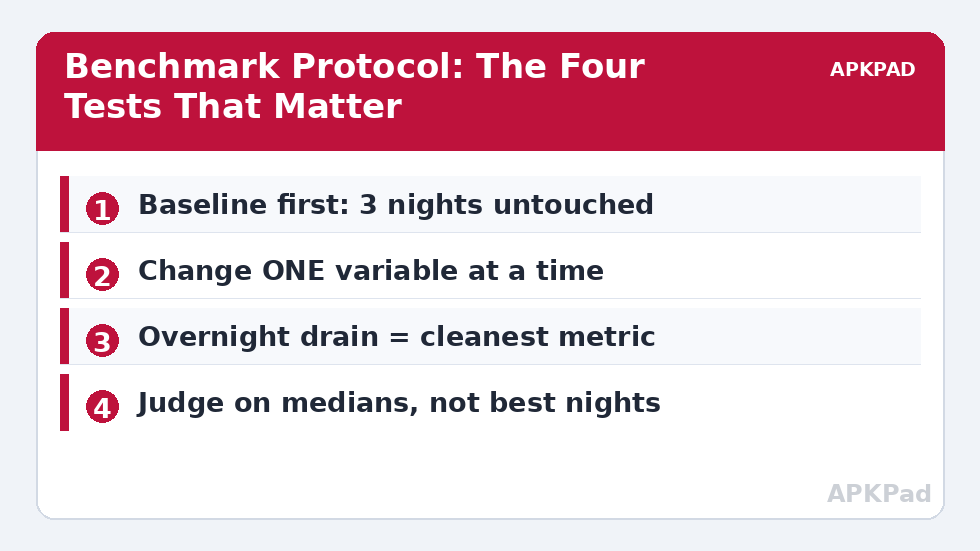
The Four Tests
| Test | Procedure | What It Proves |
|---|---|---|
| Overnight idle drain | Charge to 100% (or note start %), leave phone untouched 7–8 h, note end %. Repeat 3 nights; take the median | The cleanest single number for idle behaviour — radios, sync, wake-locks |
| MacroDroid’s own share | Settings → Battery after a normal day | Whether your automation system is a cost centre (see wake-lock audit) |
| Standardised screen-on hour | Same task (e.g. one hour of the same offline video at fixed brightness, radios in a fixed state) | Display/refresh/brightness questions, controlled |
| Full-day endurance, median of 3 | Normal use, similar days, record % remaining at bedtime | The only number that ultimately matters — noisiest, hence 3 days and medians |
How to read this: the estimate adds a small always-on idle cost for MacroDroid itself (about 0.4% of battery per day) to a per-class daily cost for each trigger type you use, scaled slightly by how many macros you run. These are planning estimates from that transparent model — not measurements from your phone. Use them to compare setups before you build, then confirm against the real numbers under Android Settings → Battery.
Running an Honest A/B Test on a Macro
Pick one macro — say the idle drain routine. Baseline: three nights with it disabled, overnight test, record the median drain. Treatment: enable only that macro, three more nights, median again. The difference between medians is your estimate, with an honest error bar of roughly ±1 percentage point from night-to-night variance. If the difference is smaller than the noise, the correct conclusion is “no measurable effect on my phone” — a result, not a failure, and the macro may still earn its place for non-battery reasons (the night airplane schedule also buys silence). AccuBattery-style apps help by logging charge sessions and estimating capacity and drain rates over weeks, smoothing exactly this noise — use one as a notebook, not an oracle: its capacity estimates drift, but its session history is genuinely useful for spotting the week something changed.
Reading Battery Stats Without Fooling Yourself
Three traps. Percentage share is relative: an app at 8% on a day your battery lasted 20 hours consumed less than an app at 4% on a day it lasted 8. Compare milliamp-ish quantities or durations, not just shares. The first day after any change lies: Android relearns, caches rebuild, and you play with the new setup — exclude day one from every treatment. A reboot is a confound: if enabling your macro coincided with a restart that cleared a stuck process, the macro takes credit for the reboot’s fix. When a result looks implausibly large, suspect a confound before celebrating. This scepticism is the house style of the whole battery hacks collection; a benchmark habit is what turns twenty tips into a system tuned to one phone: yours.
Keeping a Benchmark Notebook
Method without records decays into vibes. Keep the notebook stupidly simple — a single note or text file MacroDroid itself can append to — with five fields per test: date, condition (baseline or which macro), overnight start %, overnight end %, and one line of context (“weak signal at in-laws”, “OS updated Tuesday”). Ninety seconds per entry, and within a month you own something no forum can give you: your phone’s personal response curves to your actual automations. The context line matters disproportionately; six months later, the outlier nights are only interpretable because past-you wrote “hotel, 1 bar of signal”. Review the notebook quarterly, retire what the numbers retired, and re-baseline after major OS updates, battery replacements or a change of home or job — all of which quietly alter the system you thought you had measured, invalidating conclusions drawn on the old one.
The Benchmark Mindset, Applied Beyond Battery
Close with the generalisable point. Every claim in consumer technology — chargers, “AI optimisers”, miracle cases, this website’s other articles — is a hypothesis about a population of devices, and your device is a sample of one. The four tests in this guide are a template for sample-of-one science: baseline first, one variable at a time, medians over anecdotes, first-day data discarded, confounds named before conclusions. Readers who absorb the template stop needing articles like this one, which is the intended outcome: the battery hacks collection is scaffolding, and a user who can measure no longer needs to believe. Keep the macros that survive your numbers, delete the ones that do not — including, cheerfully, any of ours.
Worked Example: Judging One Real Claim
Put the method through its paces on a claim from this very category: “the idle routine cuts overnight drain by a third.” Baseline nights (routine disabled): 9%, 7%, 8% — median 8%. Treatment nights: 5%, 6%, 5% — median 5%. Difference: 3 points against a night-to-night spread of about 2 points within each condition — the effect is larger than the noise, so the claim survives, in the calibrated form “about 3 percentage points overnight on this phone, roughly a third”. Contrast the same test run carelessly: baseline one night (7%, a good night), treatment one night (6%) — a “saving” of 1 point that a second baseline night (5%) would have demolished. Same phone, same macro, two conclusions differing by honesty. This is why the guide insists on medians of three: not statistical vanity, but the minimum apparatus for the numbers to mean anything at all. Run your own worked example on whichever macro you install next; the notebook habit generalises, and within a season you will hold strong opinions about your phone that are, unusually for this topic, true.
And if your notebook eventually proves that your phone, your signal and your habits leave almost nothing on the table — that the honest total of every macro in this category is a few percent a day — that is a fine result too. It means the platform is doing its job and your attention is free for the things a battery percentage was never going to buy.
Frequently Asked Questions
How many days do I need to test a battery change?
Three nights per condition for idle tests is the practical minimum; discard the first day after making the change. One-day comparisons are noise — the same phone can vary 3–4 percentage points overnight with no change at all.
Is AccuBattery’s capacity estimate accurate?
Approximately, over many sessions — treat it as a trend, not a measurement. Its real value for benchmarking is the logged history of charge sessions and drain rates, which lets you compare weeks before and after a change with the noise averaged out.
What is a normal overnight drain?
On a healthy modern phone with radios on, roughly 3–8% over 7–8 hours is common; weak signal pushes it higher, airplane mode pulls it to 1–2%. “Normal” is wide enough that your own baseline matters more than any published figure.
My macro showed no measurable saving. Should I delete it?
Not necessarily. If it costs nothing measurable either, keep it for its non-battery benefits or its value in specific situations (travel, weak-signal houses). Delete macros that cost measurably and save nothing measurably — the audit makes that a fact, not a feeling.
Can I benchmark screen-on comparisons fairly?
Yes, with a fixed task: the same downloaded video, fixed brightness, same radio state, full screen, timed hour. That controls the dominant variables well enough to compare refresh-rate or brightness claims to within a useful margin.